Larry Kahaner

Archive for the tag “creative writing”

Can I Write Novels Even if I Haven’t Had an Interesting Life?

Can I Write Novels Even if I Haven’t Had an Interesting Life?

By Larry Kahaner

I came across a blog from Guy Portman titled “10 Famous Authors’ Day Jobs” in which he lists… well… you get it.exciting life
What struck me most from reading Guy’s blog post is how many famous authors eventually gave up their day jobs (Natch. They’re famous.) and how many used what they knew from their day jobs and incorporated it into their writings.

Item: Joseph Conrad – (1857 – 1924) – Many of Joseph Conrad’s works have a nautical theme. This is not surprising considering that the author had a 19 year career in the merchant-marine, which began when he left his native Poland as a teenager in 1874.

Item: Arthur Conan Doyle – (1859 – 1930) – The creator of Sherlock Holmes was an important figure in the field of crime fiction. Doyle was also a practicing doctor, whose field of expertise was ophthalmology. He quit medicine to concentrate on writing full time.

Item: Agatha Christie – (1890 -1976) – It was during World War I that prolific author Agatha Christie began writing detective stories. At the time she was employed as an apothecary’s assistant. Her knowledge of poisons was to come in useful in her detective stories.

These authors used what they learned on the job and in life as a springboard for their stories.

But what if you don’t have an interesting job, career or life to draw upon?

There’s no such thing as a boring life.

There’s always something in your past and present that you can look to for ideas and stories. There’s always odd, interesting and compelling people in your life upon which to fashion your characters and stories. You just have to be open.

I have a writing buddy who is working on a memoir and some of the folks he talks about make for fascinating character fodder. At the time, they may not have seemed so interesting, especially to a kid, but when we get older we see their bizarreness and they become highly writeable.

But even if they don’t seem so interesting now. It’s okay.

Think of a person that you know and make him or her weirder, odder, funnier or sadder. Look for the peculiar detail that others have missed. Embellish the small but compelling parts. Expand their quirk. Exaggerate a tic.

One last thought. Here’s the entry for Bram Stoker: “Stoker is best remembered for his seminal work Dracula, but he also wrote 11 other novels and 3 collections of short stories. The author spent 27 years working as an acting manager and business manager for Irving’s Lyceum Theatre in London.”

I haven’t read his other 11 novels but I can bet his job figured into these works. As for Dracula, Stoker’s inspiration reportedly came from a visit to Slains Castle in Aberdeenshire and a visit to the crypts of St. Michan’s Church in Dublin. My guess is that these creepy places produced a strong emotional reaction in Stoker which then formed the basis for his vampire novel. Another person, though, maybe not so much.

That’s the crux of it. What produces a strong emotion in you – a person, place or thing – is what you should be writing about.

Drugs: The Author’s Other Drug of Choice – Part 2

Drugs: The Author’s Other Drug of Choice – Part 2

This guest blog from former workmate Gerry Karey, who blogs at Unhinged, grew out of a blog I wrote about alcohol and authors titled Don’t Drink and Write.

When I posted the blog on my Facebook page, Gerry commented:

“What about pot?”

To which I answered: “What about it?”

He took the challenge and looked at famous authors and their drug proclivities.

We had two bags of grass, seventy-five pellets of mescaline, five sheets of high powered blotter acid, a salt shaker half full of cocaine, and a whole galaxy of multi-colored uppers, downers, screamers, laughers… and also a quart of tequila, a quart of rum, a case of Budweiser, a pint of raw ether and two dozen amyls.  — Hunter S. Thompson, Fear and Loathing in Las Vegas

thomspons

“I hate to advocate drugs, alcohol, violence, or insanity to anyone, but they’ve always worked for me. – Hunter S. Thompson

That’s quite a picnic hamper. Mescaline, acid, cocaine, uppers, downers, screamers and laughers, oh, my.  If you can remember the 60s, you weren’t there.

Thompson was one of several mid-twentieth century writers who celebrated the use of drugs, particularly hallucinogens, and inspired and influenced a cultural movement.

Thompson is credited as the father of Gonzo journalism, a blend of fact and fiction. He may have captured the gestalt of the era as well as any writer. You just couldn’t believe everything you read, but it was an exhilarating, crazy ride.

A 2005 biography is entitled, Hunter S. Thompson: An Insider’s View of Deranged, Depraved, Drugged Out Brilliance. Thomas somehow managed to live until he was 68 when he committed suicide.

“I hate to advocate drugs, alcohol, violence, or insanity to anyone, but they’ve always worked for me,” Thompson once said. Until it didn’t.

Jack Kerouac was the key figure in the “Beat Movement.” A draft of his seminal, stream-of-consciousness novel, On The Road, was written in just three weeks and typed on a continuous, one hundred and twenty-foot scroll of tracing paper sheets that Kerouac cut to size and taped together.

It is a fascinating read. But great literature? Maybe not so much.

Kerouac continued to writes books and poetry, but nothing he wrote equaled the impact of On The Road.  How could it?

Drugs were very much part of the scene in On the Road, but Kerouac’s personal drug was alcohol. He died in 1969 at the age of 47, as a result of an internal hemorrhage caused by cirrhosis.

boroughs

“Whether you sniff it smoke it eat it or shove it up your ass the result is the same: addiction.” – William S. Burroughs

Major writers of the Beat era, all close friends of Kerouac, were Allen Ginsberg (LSD), Ken Kesey (psychedelics), William Boroughs, who was addicted to heroin, and Neal Cassady, who died of a drug overdose. “Whether you sniff it smoke it eat it or shove it up your ass the result is the same: addiction,” Burroughs said.

Other 20th Century writers who experimented with or used drugs: W.H. Auden, Jean Paul Sartre and Philip Dick (amphetamines). “Drug misuse is not a disease, it’s a decision…an error in judgment,” said Dick, who also used marijuana, mescaline, LSD, sodium pentothal. Hubert Selby, was addicted to pain killers and heroin that were first administered after surgery; Stephen King, who managed to kick his addiction to cocaine and other drugs; and Aldous Huxley, mescaline (see Huxley’s The Doors of Perception).

Would Dick have created his fantastic fictional worlds without drugs?  Would Hunter Thompson have been Hunter Thompson? Would any of those writers have achieved what they did?

Neurobiologist R. Douglas Fields asks: “Can the creative product—a song, painting, poem, or book—justify the sacrifice and harm that will accompany conducting the creative pursuit under the influence of drugs? If we accept the use of marijuana, cocaine, methamphetamine, LSD, and alcohol by rock musicians to achieve creative breakthroughs and delight us with their performance, what does that say about us in being willing to accept the destruction of another human being for our entertainment?”

“Drugs are a waste of time. They destroy your memory and your self- respect and everything that goes along with your self esteem,” songwriter/musician Kurt Cobain said.  Cobain struggled with heroin addiction and depression. He committed suicide in 1994, at age 27.

I do not know if this survey will persuade anyone not to use drugs (with the exception, perhaps of marijuana as a reward after a long day of writing). That’s not my intent. But I will reiterate Larry Kahaner’s advice to aspiring writers – all writers, for that matter:  “Write a lot and read a lot. Those are the only habits that work all the time and every time.”

There are no short cuts.

The Secret to Writing That Nobody Tells You

I am reblogging Jane’s post because it’s something that I’ve been harping on for years. Writing is work. You put your ass in the seat and write. Only when you can do this day in and day out can you call yourself a writer. You write when you feel like it and you write when you don’t feel like it – just like everyone else and their job. There are good days and bad days but you still go to work, right?

Endacott Creative's avatarWORD SAVANT

When I coach people, there is an ugly truth about writing that I often hold back from them. It’s something you can only learn through gut-wrenching, razor’s edge, shard of broken glass experience.

There is no magic to writing, none at all. It’s nothing but grueling

No magic, no easy formula, no genius algorithm. There is no “secret” that is going to make everybody love your work, buy all your books, tell their friends about you, and get stars in their eyes when they hear your name.

It is simply monotonous, repetitive work.

I recently finished the manuscript for my first novel. For eight years I struggled to finish it. And do you know what finally helped me finish it?

Monotonous, repetitive work.

I did it by sitting down (almost) every day and writing a minimum of 500 words.

Some of those days were pretty good days. I would say…

View original post 828 more words

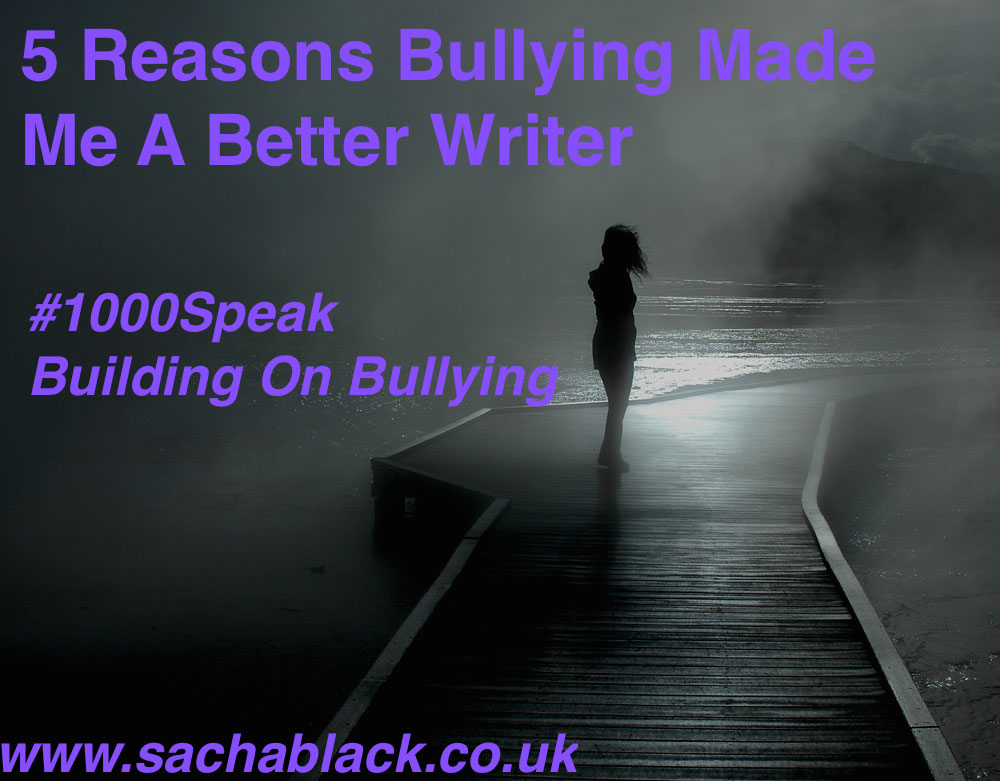
5 Reasons Bullying Made Me A Better Writer #1000Speak – Building On Bullying

I am reblogging this post from Sacha Black because of the insight she has about how bullying made her a better writer. I was never bullied, but I understand how being bullied can make someone think and feel differently than others. That’s the part – the thinking and feeling differently than others part – to which I can relate, understand and appreciate, which I believe makes me a better writer. I applaud Sacha for speaking out.

Sacha Black's avatarSacha Black

5 Reasons Bullying Made Me a Better Writer

I had to coax myself into posting this. Not because I didn’t want to do a post for #1000Speak, but because bullying is one of those things that everyone has been affected by, and I am no exception. It’s all a little close to the bone. Bullying is one of those universal topics that touches the lives of almost everyone. But I want to focus on the positive. On why being bullied made me a better writer. Without having been bullied I wouldn’t have focused on writing in my youth, and I probably wouldn’t have realised writing was my dream. So am I compassionate with the bullies? No, probably not, I know that’s the point of 1000speak, but, I am grateful for the experience of bullying.

View original post 999 more words

Why Writers Should Read Crap

Why Writers Should Read Crap

By Larry Kahaner

elsewhere

Thanks to sblazak.wordpress.com for this headline.

All writers get the same advice. Read the great writers; study the great works. Learn how seasoned, professional and successful authors get the job done. All true, but I maintain that it’s also crucial for writers to read crap to learn what not to do.

How do you know what’s crap? It’s not a book that didn’t sell well, although that sometimes may be a clue. It’s not one that received bad reviews either. Some of the world’s greatest books have garnered negative comments from critics. Crappy writing is like the U.S. Supreme Court’s ruling on what constitutes pornography. You know it when you see it. And you know it because you’ve mainly been reading good writing.

More concrete indications of bad prose are sections that make you go ‘huh?’ or that make you laugh because they’re so ridiculous even though the author meant it to be serious. It’s prose that’s boring, even if you can’t articulate why your mind is wandering. Crappy writing just doesn’t sound right to your ear.

Other bad writing signs include no variation in sentence length, too much telling instead of showing, overshowing, no drama, no emotion, backstories that are too long, unnecessary detail, and on and on. I’m not talking about mechanical problems with grammar or lapses in POV or tense but simple, bad freakin’ writing.

Here are some examples from real self-published books. I have changed the wording slightly so as not to embarrass the author.

Sample: “We have to move quickly, pal. We already have an elite team on its way to Nigeria to rescue the pilot. But these paratroopers are going to stand out like chocolate chips in vanilla ice cream without some assistance on the ground. I need someone to be there to meet them or they’ll be minced meat.”

What did you learn? It’s trite and boring because the writing is obvious, full of clichés and the ‘chocolate chips?’ Make it stop. Send the elite team? Why would you send the non-elite team? And yes, we do have to move quickly because moving slowly would… well.. you know.

Sample: “Hi, Bob! Sorry, I’m so late! She awkwardly returned the kiss, her kitbag bumping against her knees and her laptop bag hanging from one shoulder.”

What did you learn? First, cut the exclamation points. You’re allowed only a few per book and they should be reserved for “Look out!” like when a rock is falling on a character’s  head. Show me how she ‘awkwardly returned the kiss;’ don’t tell me. Last, who cares about her kitbag hitting her knee or that her laptop bag hanging from one shoulder? (Can a laptop even hang from two shoulders?) What does that sentence add? Mood, ambience, emotion, anything? Nothing! (I used the exclamation point because I felt that I was in danger.)

I was going to offer one more example, but this exercise made me a little sick to my stomach, so I’ll stop here.

Again, why read crap? So you know what not to do. You’re learning from others’ mistakes without people like me making fun of you in this blog. We are all guilty of lapses in writing judgment. I have made the same mistakes that I detailed here (which I seek and destroy in the rewriting process) especially because I come from the non-fiction side of writing books where some of these transgressions – like telling instead of showing – is not only acceptable but encouraged. In fact, one of the tenets of non-fiction writing is “tell people what you’re going to tell them; tell them; then tell them what you told them.” Do this in fiction and you’re inviting readers to pummel you.

My advice is to read some crap every once in a while but not too much. And don’t pay for it. Please. Read the free samples on Amazon. You only have to read (thankfully) the first few pages to learn their abject lessons.

Why Do So Many People Write at Starbucks?

By Larry Kahaner

Why do so many people write at Starbucks?

The answer has to do with me going to Nevis.

View of St. Kitts from Nevis with rainbow bonus.

View of St. Kitts from Nevis with rainbow bonus.

Let me explain.

Brain researchers don’t quite understand it all, but they’re learning more and more about something called ‘neuroplasticity.’ This is the brain’s ability to change neural pathways and synapses due to changes in behavior, environment, thinking, emotions and, of course, an unfortunate conk on the noggin. These changes in neural pathways and synapses determine, among other things, our creativity.

This means that your brain actually changes its functional structure based on your thoughts, environment and the other items listed above. What does this have to with writing? Simply put, by changing our neural pathways and synapses we can be more creative in our fiction as well as non-fiction writing. One way to do this is through a change in scenery.

I recall many times having trouble figuring out the approach to a feature article I was writing. Getting away from the office, even for a short while, really helped solidify my thoughts. The same went for my non-fiction books. Getting away always worked. A change often led me to ‘aha moments’ and I could see a whole book’s organization and structure in my mind’s eye for the first time.

Dune_Shacks_of_Peaked_Hill_Bars_Historic_District

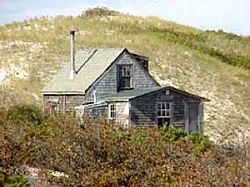
Dune shack of Cape Cod.

Consider the Dune Shacks of Cape Cod. These ramshackle huts built for washed- up-on-the-shore sailors have offered help to the likes of Jack Kerouac, Norman Mailer, e.e. cummings and Jackson Pollack. Before modern science stepped in we thought the structures’ powers lay in solitude, beauty and the sound and smell of the surf. People used the word inspiration. Sorry. It’s just that it was different – very different – from where the writer/artist usually lived and worked. Not only was the scenery dissimilar to home but the shacks had no running water, electricity or other everyday amenities. How’s that for different? They still don’t offer creature comforts and you can enter into a lottery to try one for yourself.

You’re probably thinking that we writers have always known that a change in environment is good for our writing. Now we know why. The science is solid.

Writers often thrive in artistic and literary retreats. It’s not that the environment is so conducive to writing – although it may have to do with not having to cook your own meals or handling everyday family tasks – but, again, it’s that it’s different. A good pal of mine just returned from such a place where he clocked about 4,000 words a day while in residence. He claims his output was due mainly to being relieved of his daily household chores, but I’m going with the science.

By changing our environment, we change what we see, what we smell, how we feel and what we think. This helps to get us out of our brain ruts which have been worn deep by doing and seeing the same things day in and day out. Scientists now tell us that these ruts are real and not imagined. Leaving these ruts puts us on new paths of thinking and understanding and that’s always good for writers, fiction and non-fiction alike.

I can tell you right now that being on the island of Nevis is helping my ability to churn out new thoughts and ideas, and not just about writing. At the risk of being too obvious, Nevis is very different from where I live outside of Washington, DC. Nevis is lush and warm. It’s a roundish, volcanic island with one extinct cone in the middle, Nevis Peak, which is often shrouded in clouds. Yep; it’s different.

n p[eak

Nevis Peak

But you don’t have to get on an airplane to get the same benefits of being in a different place. It doesn’t take much.

Sometimes I just move my laptop to my dining room table and that helps clear the cobwebs. Other times I sit in Starbucks and enjoy some flashes of writing fervor. It’s not the coffee or the slow internet that wires me for greater word output.  It’s being out of  my everyday office.

Instead of grinding away in the same digs, change your venue. Even small changes in your work environment can move your writing to new places.

What if the US were run like a corporation and a madman was in charge? Check out my latest thriller USA, Inc. now available in eBook and paperback. Money-back guarantee. 

Post Navigation

Improve With Soo-Self Development

Good habits, productivity and happiness.

Soul Escape

This and That...

Poetry by thehobartchinaman

Poetry, experimental, ditties, mostly with a twist. From www.thehobartchinaman.wordpress.com

Self Help Blog

Positive well-being and Mental Health

How To Love Your Life

Change a habit and change your life!

Subdued Flamboyance

Poetry by Dr. Abhinav Majumder

BrawBlether

Thoughts about Scotland & the world, from a new Scot

siggiofmaine

An Artist, Photographer, Writer, Poet

Silent Songs of Sonsnow

"I have enough time to rest, but I don't have a minute to waste". Come and catch me with your wise words and we will have some fun with our words of wisdom.

Darrick Dean

Find your Purpose. Find your Story.

The Lime Squeezes; The End of The Beginning

Semi-colons: the beloved penny; stop killing: poetry

keithgarrettpoetry

Smile! You’re at the best WordPress.com site ever

Fantasy Road

The Journey begins here.

Beyond Love Existence

- A part of JTCHlife’s mind

Creole Bayou

Laissez les bons temps rouler!

Veronica Knox

Artist & Author